
OpenSTEF
OpenSTEF (Open Short-Term Energy Forecasting) is an open source Python package that provides automated machine learning pipelines for short-term energy load forecasting.

OpenSTEF (Open Short-Term Energy Forecasting) is an open source Python package that provides automated machine learning pipelines for short-term energy load forecasting.
OpenSTEF is collaboratively developed by a growing community of grid operators, technology vendors, researchers, and energy-sector experts, and is hosted at LF Energy. It generates probabilistic forecasts for hours to days ahead for any given energy signal, enabling grid operators, energy companies, and researchers to anticipate congestion, support grid safety analysis, and optimize flexible assets. The latest release, OpenSTEF 4.0, introduces a fully redesigned modular architecture that broadens the range of forecasting applications and reduces implementation effort.
Load and generation forecasts with uncertainty quantification
The ML pipelines ensure that forecasts adapt as load patterns evolve
Deployed at scale in production at multiple organisations
OpenSTEF can be integrated into any IT infrastructure environment
Supports electricity, thermal, and potentially other energy systems
MPL 2.0 license, which enables commercial use and customization with lightweight open-source requirements.
OpenSTEF combines a complete forecasting library with proven presets and a modular, extensible architecture designed for operational energy environments.
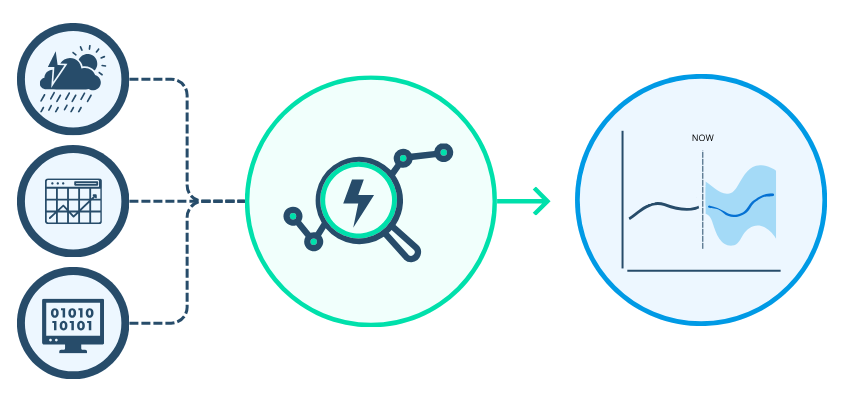
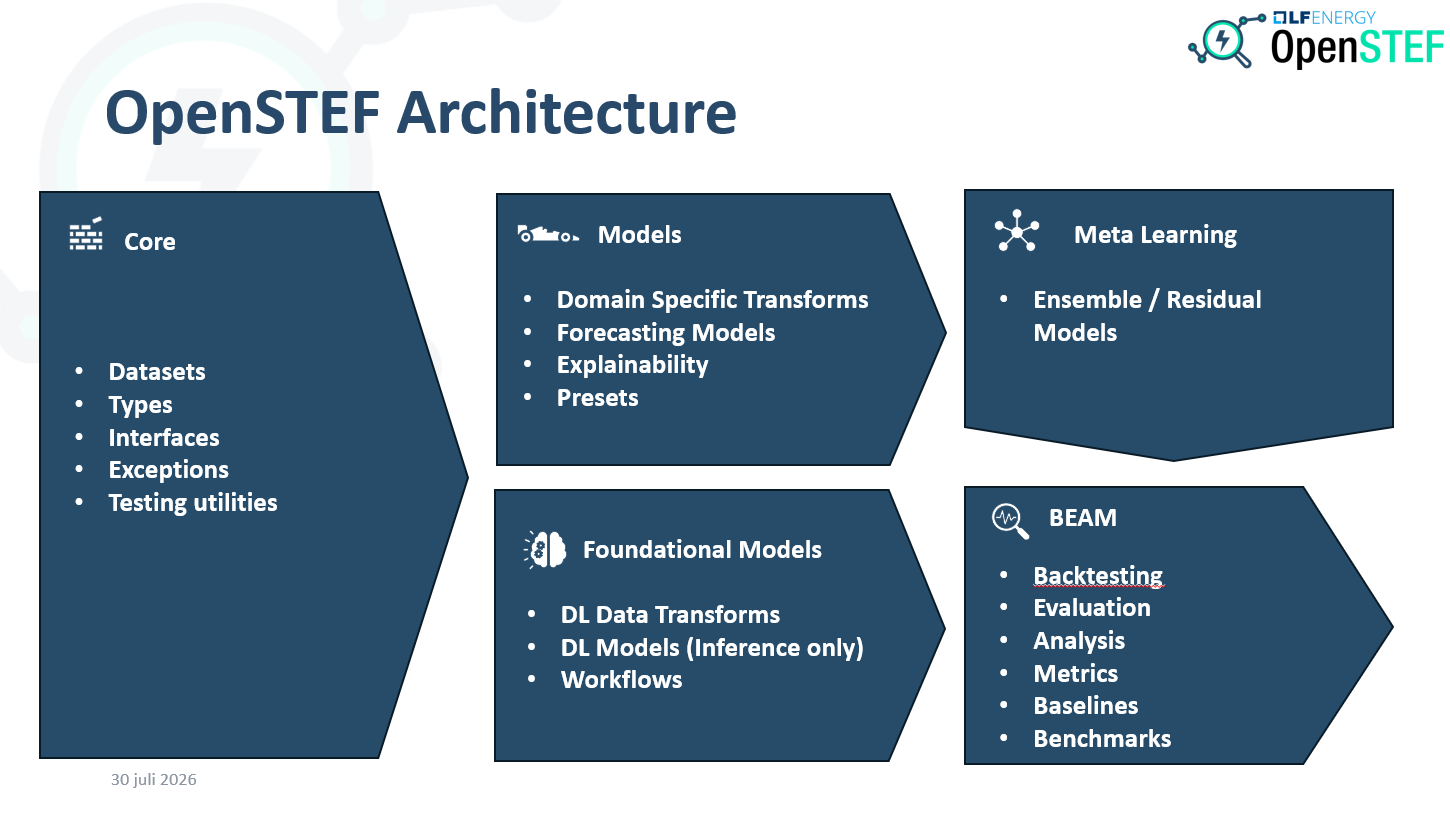
The new design makes it easier to tailor forecasting pipelines to your specific use case. Whether that’s adapting to your data, integrating with your IT environment, or experimenting with different modeling approaches. You can easily change, add, remove, adapt pre-processing and other steps of the pipeline.
OpenSTEF 4.0 gives users full freedom to shape their own forecasting setup. Integrate your domain knowledge on feature engineering with ease. And whether you prefer to use classical machine learning, ensemble modelling techniques or a foundational model, openSTEF supports it all. It also provides the tooling around those ML components to ensure everything works smoothly in production. From researching new ideas to deploying to production at scale, OpenSTEF 4.0 contains all modules needed to support your workflow.
Alliander, the largest distribution system operator in the Netherlands, uses OpenSTEF in production at thousands of grid locations. These forecasts are used as input for congestion management, the communication of energy exchange with the transmission system operator and for estimating grid losses.
Sigholm implemented OpenSTEF as the forecasting engine behind its Aurora production optimization platform for district heating and combined heat and power systems. The platform now generates approximately 20,000 forecasts per week, completing each forecasting cycle in about 4 seconds. Aurora optimizes approximately 40% of Sweden’s district heating production.
Participation is open and collaborative. Anyone may: